Can Companies of Different Sizes Benefit from eLearning?

In Australia’s competitive and compliance-driven business environment, companies of all sizes are under pressure to ensure their employees are properly trained, up to date with legal requirements, and able to perform their duties safely and competently. Whether you’re a national enterprise, a growing mid-sized organisation, or a small business, one thing remains true: training matters.
Historically, eLearning was seen as something reserved for large organisations with deep budgets and dedicated HR teams. But that perception has changed. Today, eLearning is accessible, scalable, and effective — and businesses of all sizes are discovering its value.
In this article, we explore how Australian companies of every size can benefit from eLearning and how it can align with both accredited and non-accredited training frameworks used nationally.
Why eLearning Works — Regardless of Company Size
At its core, eLearning is about delivering training digitally — whether that’s through interactive modules, videos, assessments, or virtual classrooms. This format offers greater flexibility, consistency, and scalability compared to face-to-face or manual training delivery.
What’s more, eLearning is highly customisable, meaning it can be designed to support:
- Accredited training aligned with the Australian Qualifications Framework (AQF)
- Internal compliance and onboarding modules
- Industry-specific content (e.g. safety, equipment use, data privacy)
- Enterprise-wide learning strategies or microlearning for smaller teams
No matter your size or sector, there’s a way to make eLearning work for your business.
1. Small Businesses: Agility and Affordability
Common Needs:
- Fast, simple onboarding of new staff
- Safety or compliance training (e.g. manual handling, PPE, workplace behaviour)
- Policy awareness and sign-off
- Basic upskilling
How eLearning Helps:
Small businesses typically don’t have in-house trainers or HR teams. eLearning enables you to:
- Deliver the same training experience every time, reducing reliance on senior staff
- Host your training online, meaning learners can complete it at their own pace
- Track completions for insurance, legal, or WHS purposes
- Save money on venues, travel, and printing
In Australia, many small businesses use affordable LMS platforms like Moodle, Thinkific, or Coassemble to deliver their internal training. These platforms can host video, PDF, and quiz-based training content with minimal technical knowledge.
✅ Bonus: Non-accredited training doesn’t require AVETMISS reporting, so smaller businesses can avoid the added complexity of Student Management Systems (SMS).
2. Medium-Sized Enterprises: Efficiency and Scalability
Common Needs:
- Consistent onboarding across multiple sites or teams
- Compliance with national and state-specific safety legislation
- Upskilling for frontline managers and team leaders
- Tracking and reporting for HR, insurance, or ISO audits
How eLearning Helps:
For medium-sized businesses, training starts becoming harder to manage manually. eLearning platforms:
- Scale with your workforce — no matter how many new hires you onboard
- Provide centralised dashboards so HR or WHS teams can monitor completions
- Allow content updates in real time (essential when SOPs or regulations change)
- Integrate with HR systems or productivity tools like Microsoft Teams or Google Workspace
If your company operates in construction, logistics, or resources, this is especially valuable — as training content can be tailored to reflect site-specific risks or job roles.
Mid-sized organisations may choose a platform like Cloud Assess or aXcelerate (especially if delivering accredited training) for stronger automation, user roles, and compliance features.
3. Large Organisations and Enterprises: Standardisation and Compliance at Scale
Common Needs:
- Workforce-wide training programs for thousands of staff
- Accreditation and formal qualifications (e.g. Cert III in WHS)
- Enterprise-level compliance (WHS Act, ISO 45001, industry standards)
- Multi-site, multi-role, and multi-level training matrix management
How eLearning Helps:
For large organisations, eLearning is the only practical way to deliver:
- Consistent messaging and branding across business units
- AVETMISS-compliant data collection for formal training providers or RTO partnerships
- Role-based learning paths, ensuring employees only complete training relevant to their position
- Evidence of competency for regulators, insurance providers, or audits
Large organisations often use platforms such as Moodle Workplace, Canvas, or Ready LMS, which offer:
- Bulk user management
- Single Sign-On (SSO)
- Integration with HRIS and payroll
- Automated reporting and dashboards for leadership teams
When delivering nationally recognised qualifications internally or through a partnered RTO, the LMS must integrate with a compliant Student Management System and be audit-ready for ASQA or NCVER submissions.
What About Accreditation and Compliance?
Not all training in Australia needs to be accredited — but all training must be fit for purpose, especially under the Model Work Health and Safety Act.
For accredited training:
- The LMS must support assessment mapping to training package requirements
- Your business (or partner RTO) must issue Statements of Attainment
- Data must be reported using AVETMISS format to NCVER
For non-accredited in-house training:
- The focus is on competency, documentation, and tracking
- There is no AVETMISS requirement, but you must still maintain evidence of participation and completion
- This applies to inductions, SOP training, safety refreshers, and policy rollouts
✅ Many Australian businesses use a blended model — combining non-accredited internal training with occasional accredited modules delivered through an RTO.
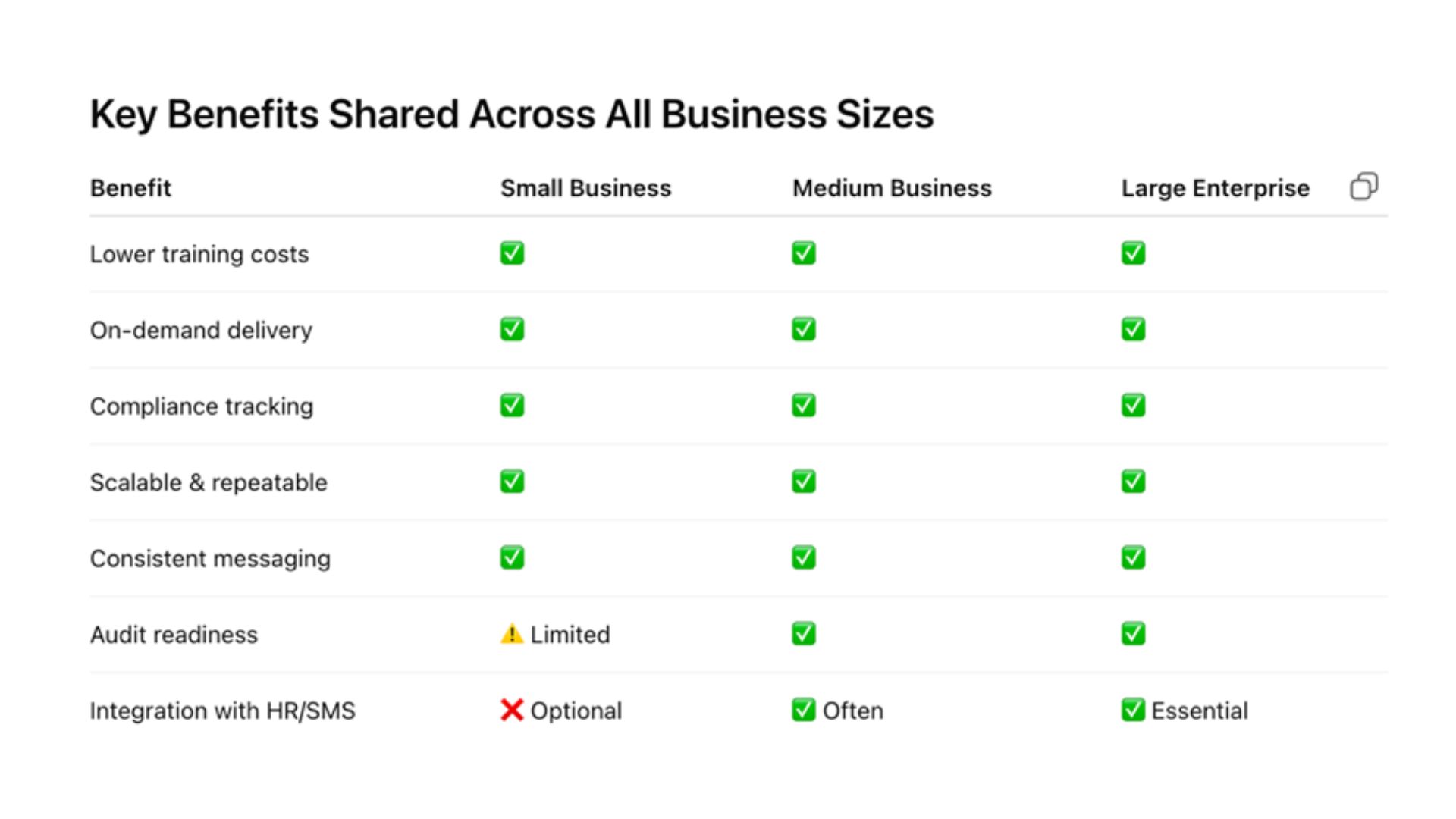
Choosing the Right LMS for Your Size
Here are some general LMS recommendations based on company size and complexity:
Small Business
- Moodle Cloud, Thinkific, Coassemble, TalentLMS
- Easy setup, low cost, and good for self-hosted content
Medium Business
- Cloud Assess, aXcelerate, Go1
- Supports compliance reporting, offline use, and scalable enrolment
Large Enterprise
- Moodle Workplace, Canvas, Ready LMS, Totara Learn
- Feature-rich, AVETMISS-ready, with deep integrations and analytics
Final Thoughts
No matter the size of your organisation, eLearning offers measurable, practical benefits. From reducing training costs and increasing engagement to supporting compliance with Australian laws and frameworks, digital learning is no longer just a “nice to have” — it’s a strategic business asset.
Whether you’re training five people or five thousand, eLearning platforms can be scaled, customised, and aligned to suit your specific needs — without compromising on quality or compliance.
Need help getting started?
We help Australian businesses of all sizes choose, customise, and roll out eLearning systems that align with their goals, regulatory requirements, and budget. Whether you need accredited solutions, safety-focused inductions, or just want to modernise how you train, we’re here to help.
Let’s talk.